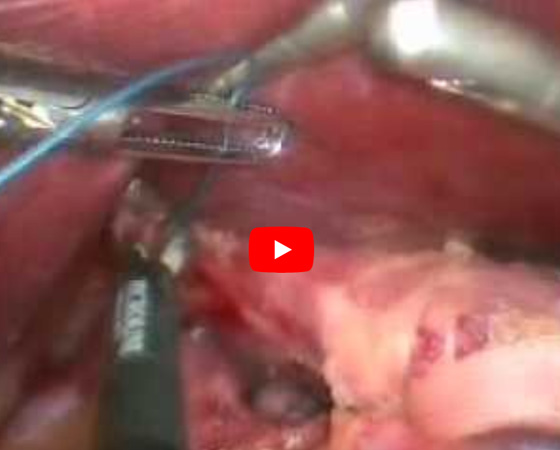
Hiatus Hernia - Laparoscopic Nissen Fundoplication - Operative video
Hiatus Hernia - Patient Education video
This is performed for the treatment of hiatus hernia and gastro-oesophageal reflux.
What is hiatus hernia and gastro-oesophageal reflux?
Our stomachs are normally within the belly (abdomen). A muscular partition called the diaphragm separates the abdomen from the chest and has an opening (hiatus). through which our gullet (oesophagus) enters into the abdomen. Hiatus hernia is a condition where a part or the whole of your stomach slips up from the abdominal cavity (belly) into your chest. As a result the acid in the stomach can enter the oesophagus (gullet) and irritate the lining – this is know as GORD (Gastro-Oesophageal Reflux Disease) or GERD. This can cause heartburn, dyspepsia, belching and discomfort (abdomen and chest) due to irritation of the lining of the gullet. Sometimes the acid can enter the upper gullet, voice box or the airway leading to altered voice, cough or bad breath. These symptoms can be aggravated by putting on weight, smoking, stressful life, heavy meals, certain food (like oranges, tomatoes, tea, coffee etc) and certain medication (steroids and some painkillers).
What symptoms may I suffer from if I have a hiatus hernia?
Patients may experience heartburn, upper abdominal pain, bitter fluid in the throat and belching. Some may experience chronic cough, especially in the early hours.
How is a hiatus hernia or GORD / GERD diagnosed?
Hiatus hernia can be diagnosed by performing an endoscopic examination of the oesophagus and stomach (often called Gastroscopy or OGD). Your GP or gastroenterologist may already have arranged this prior to referring you to the hospital – otherwise your surgeon will arrange this. Your surgeon may sometimes request additional tests to assist in the diagnosis e.g. a barium swallow x-ray or a CT scan may be arranged if your hiatus hernia is very large or you cannot undergo an OGD. Finally, a functional test called Oesophageal Manometry and pH Study can demonstrate if your gullet functions normally (oesophageal physiology) and can help to distinguish between GORD and abnormal contractility of the oesophagus.
Management of hiatus hernia and GORD
There are two main ways to treat hiatus hernia. Measures like losing weight, avoiding heavy meals, avoiding late night meals, avoiding food / medication that aggravate symptoms are the first line of treatment. It is usual to prescribe some form of antacids or acid reducing medication – this does not treat the hernia but reduces your symptoms by lowering the acid in your stomach. Your surgeon may prescribe you medicines to reduce the acid secretion in your stomach. Less acid in the stomach will usually mean that less is available to flow up (reflux) into the gullet and your symptoms will usually be relieved. However, if you have bile entering your stomach and the gullet then reducing the acid in the stomach may not help to relieve your heartburn. You will also feel better if you avoid heavy meals, lose weight and avoid smoking. If you are happy with these measures then you may not need any other treatment. One concern with long-term medication is the concern that patients are more at risk of developing infective diarrhoea.
If you respond to acid-reducing proton pump inhibitors (PPI) and are content with continuing with medical management for life then you do not require surgery. However, if you are unwilling to continue to take medication long-term then an operation to refashion the valve that controls acid reflux may help. There are a number of anti-reflux operations but the common element is to repair the hiatal defect and wrap the upper stomach around the lower gullet (fundoplication). These operations can be performed using keyhole surgery.
You may like to consider hiatus hernia surgery if you have –
responded fully or partially to acid-reducing medication and
are not content to take medication for life
There are a number of laparoscopic hiatus hernia operations like Nissen's fundoplication, Dor Fundoplication, Toupet’s Fundoplication etc. – these may offer long-term resolution of symptoms when combined with hiatal repair.
What happens at the first appointment?
Your surgeon will initially take a history, examine you and perform appropriate tests to identify the cause of your symptoms. He will also ensure that you are fit to undergo any procedure / surgery and an anaesthetic. He may also suggest initial trial of medical treatment for your symptoms.
What happens at the subsequent appointments?
He will check that all necessary information and reports are available and have been evaluated. He will discuss the results and reports of various investigations. He will assess your response and satisfaction with the trial of medical treatment for your symptoms. He will discuss with you the various options available to treat your symptoms. If you want to undergo anti-reflux surgery then he will agree with you a date for the procedure.
Admission for surgery
You must not eat any food from 6 hours before the operation. You are allowed to drink clear fluids, including tea and coffee without milk up to 3 hours before the operation. A nurse will admit you on the day of surgery. The surgeon and the anaesthetist will see you prior to your operation. They will confirm that you are willing to undergo surgery, all preparations are complete and it is safe to proceed with your operation. They will confirm that an appropriate facility is available for you to recover after surgery.
What happens during hiatus hernia surgery?
Your surgeon will make 5 small cuts in your abdominal wall and introduce carbon di-oxide into your abdomen to help see everything properly. He will then use a small telescope (laparoscope) and fine instruments to repair your hiatus with stitches (if the defect is small) or a mesh (if the defect is large). He will then create an artificial valve at the lower end of the oesophagus (gullet) by wrapping the upper part of the stomach and creating a wrap – this is known as a fundoplication.
Risks of hiatus hernia surgery
All operations carry some risks which have to be weighed against the risks of complications if you do not undergo surgery. General risks of complications following an operation include risks of sore throat, pain, infection, bleeding, pneumonia / atelectasis (collapsed lung), thrombo-embolism (clots in leg veins or in lungs), heart attack, stroke and death – these complications are rare. There is a 1% risk that your surgeon is unable to complete the operation laparoscopically and has to convert the procedure to open surgery due to intra-operative difficulty which is a threat to your well-being. The risk is higher if you have undergone previous hiatus hernia repair or open abdominal surgery. There is a 20% risk that you may experience difficulty in swallowing (dysphagia) - usually transient, although in a small proportion of patients further treatment (endoscopic dilation or another operation) may be necessary. It is common to experience a degree of bloating and finding it more difficult to belch or vomit. Other risks include a risk of perforation, increased flatulence, a change of bowels and port-site / incisional hernia.
Outcome of Hiatus Hernia Surgery
Following surgery there is resolution of symptoms in 80% of patients and the remainder require PPIs at a lower dosage. Some patients (2-17%) may experience recurrent symptoms several years after surgery requiring a resumption of medication or revision surgery.
What happens in hospital after surgery?
You will be sent to the Ward after the procedure. You will be looked after by a nurse and offered appropriate pain-killers. You will be offered fluids to drink but you will not be allowed to eat solid food. Usually the procedure is performed as a day case or a short 1-2 day hospital stay and you will be able to return home when it is safe to do so. You will have a few small wound dressings which you can remove yourself after 1 week or a nurse / the surgeon can remove these at a subsequent visit. You will need to have a responsible and capable adult to take you home and to look after you for the first 24 hours. You should not operate machinery during this period.
Support available during early recuperation period after surgery
It is advisable to consume liquids only for the first 1-2 weeks to allow the swelling around the gullet to settle. You will gradually progress through soft diet to normal diet over 1-2 months. It is usual for you to experience some initial difficulty in swallowing and pain in the wounds - you may also experience minor discomfort in the shoulder. It is advisable to avoid strenuous physical activity for the first 2 weeks to allow proper healing of the wounds. Most patients recover fully within 1-2 months. You will be given a number to ring for advice in case of difficulty.
Further follow up after surgery
You will be given an appointment to see the surgeon again - he will ensure that you are recovering as expected.
Will further surgery be needed?
This is usually not necessary, though rarely corrective endoscopy or surgery may be required if you experience unexpected symptoms.
What happens if you decide not to undergo surgery for hiatus hernia?
You may be content to continue with medication for life and other conservative measures. However, if you do not undergo surgery, you can experience progression of your symptoms requiring you to take higher doses of medication to reduce acid in your stomach. You may also develop complications e.g. inflammation of the gullet (oesophagitis), precancerous changes in the lining of the gullet (Barret's metaplasia), giant hiatal hernia with gastric volvulus (stomach in the chest with twisting of its blood supply leading to necrosis of the stomach) etc.
Returning to work:
You may return to light work as soon as you feel comfortable - this is usually possible within 2 weeks of the operation. You should avoid strenuous physical activity or heavy lifting for 4-6 weeks.
What are the indications for surgical treatment?
Surgical therapy should be considered in individuals with documented GERD who:
are not compliant to medical therapy,
opt for surgery despite successful medical management (due to lifestyle considerations including age, time, or expense of medications),
have complications of GORD (e.g., Barrett’s oesophagus, stricture, grade 3 or 4 oesophagitis),
have “atypical” symptoms (asthma, hoarseness, cough, chest pain, aspiration) and reflux documented on 24-hour pH monitoring.
Consensus conference of the European Association for Endoscopic Surgery (1997 ).
Even after successful medical acid suppression, the patient can have recurrent symptoms of epigastric pain and retrosternal pressure as well as food regurgitation due to an incompetent cardia, insufficient peristalsis, or a large hiatal hernia.
Concerning the indication for surgery, a distinction between heartburn and regurgitation symptoms is considered important (medical treatment appears to be more effective for heartburn than for regurgitation). Therefore the indication for surgery is based on the following facts:
Non-compliance of the patient with ongoing effective medical treatment. Reasons for non-compliance are preference, refusal, reduced quality of life, drug dependency and drug side effects,
Persistent or recurrent oesophagitis in spite of currently optimal medical treatment and with or without symptoms,
Persistent regurgitation;
Complications of the disease: ulcers, stenoses, and Barrett’s oesophagus have minor influence on the indication (neither medical nor surgical treatment has been shown to alter the extent of Barrett’s epithelium).
NOTE: Patients with symptoms completely resistant to antisecretory treatment with PPIs are bad candidates for surgery. In these individuals other diseases have to be investigated carefully. Good candidates for surgery should have a positive response to antisecretory drugs.
Diet after Nissen Fundoplication / Hiatal Hernia Repair
The upper part of the stomach (fundus) is wrapped around the gullet (oesophagus) during a hiatal hernia repair – these swell in the period immediately after surgery. As a result most patients may note the following symptoms after their operation.
Difficulty in swallowing (dysphagia).
Abdominal bloating and pain after eating (gas bloat syndrome).
These symptoms may last between 2-6 weeks. The following diet can minimize these symptoms.
FIRST STAGE: LIQUID DIET STAGE
When do I start this and how long do I continue to follow this?
You can start sipping immediately after surgery until 1 week after surgery - later you can drop back to the FIRST STAGE if you experience problems with SECOND STAGE.
What do I do?
You can drink any non-alcoholic and non-fizzy liquids, but please follow the instructions below:
Sip any amount of soup, tea, coffee or milk, 3-4 times daily, or more often if you wish.
You should aim to drink at least 3-4 pints (1.5-2.0 litres) in a given 24 hour period.
Drink slowly.
Avoid extreme temperatures.
Allow cold drinks / ice to melt and warm up in your mouth before swallowing – otherwise your gulled may go into spasm and you may feel very uncomfortable and suffer from pain.
Avoid carbonated drinks for a minimum of 3-4 weeks – otherwise you may feel very uncomfortable and bloated!
SECOND STAGE: SOFT DIET STAGE
When do I start this and how long do I continue to follow this?
You can start this from 1 week after surgery until 2 weeks after surgery or as tolerated.
What do I do?
You can eat any soft food (items one could eat without teeth), but please follow the instructions below:
Eat soft foods like mashed potato, soft fish, scrambled eggs, humus etc.
Eat or drink slowly over a ˝ -1-hour period until you feel full.
Chew your food well.
Drink fluids with food to keep food moist.
Limit the following "gas-forming / irritating" foods. Tomato products, peppermint, black pepper, caffeine, alcohol, onions, green peppers, "gum chewing", menthol, fatty foods, beans, spicy foods, nuts, citrus fruits, raw fruits, raw vegetables, fibre supplements.
Avoid breads, crackers, biscuits, pancakes, waffles, and French toast.
Avoid dry meats (like cold cuts).
Avoid carbonated drinks for a minimum of 3-4 weeks – otherwise you may feel very uncomfortable and bloated!
Drop back to First Stage (liquid diet) as needed if you experience bloating or difficulty in swallowing – contact your dietician / surgeon if you have to do this for more than a week.
THIRD STAGE: TRANSITION TO REGULAR DIET
When do I start this and how long do I continue to follow this?
You can start this from 2 weeks after surgery until 3-4 weeks after surgery or as tolerated.
What do I do?
You can eat any soft food (items one could eat without teeth) and start to introduce solid food in your meals, but please follow the instructions below:
Eat soft diet as above.
Begin introducing more challenging foods one at a time.
If they cause symptoms, avoid them and try reintroducing them at a later date.
Eat or drink slowly over a ˝ -1-hour period until you feel full.
Chew your food well.
Drink fluids with food to keep food moist.
Drop back to Second Stage (soft diet) as needed if you experience bloating or difficulty in swallowing – contact your dietician / surgeon if you have to do this for more than a week.
For bloating try taking GAS-X® (available over the counter) with meals.
No carbonated drinks for 3-4 weeks
FOURTH AND FINAL STAGE: REGULAR DIET
When do I start this and how long do I continue to follow this?
You can resume normal diet from 3 to 6 weeks after surgery, depending on how you tolerate the above stages. If you are experiencing difficulty in eating normal food then contact your dietician / surgeon as you may require further measures to help you eat normally.
What do I do?
Eat regular healthy diet.
You can also find this information on my website www.cebls.com.